

On July 27, 2026, Amazon changes how product titles work for every non-media category. The single 200-character title field you've optimized for years is being split into two separate attributes: item_name and title_differentiation — the new "Item Highlight."
If you sell on Amazon, or you manage listings through any tool built on the Selling Partner API, this affects you. Here's everything you need to know — what's changing, who's affected, the one restriction that catches most sellers off guard, and how to restructure your entire catalog without spending a week in spreadsheets.
What exactly is changing?
Today, an Amazon product title is one field: item_name, up to 200 characters.
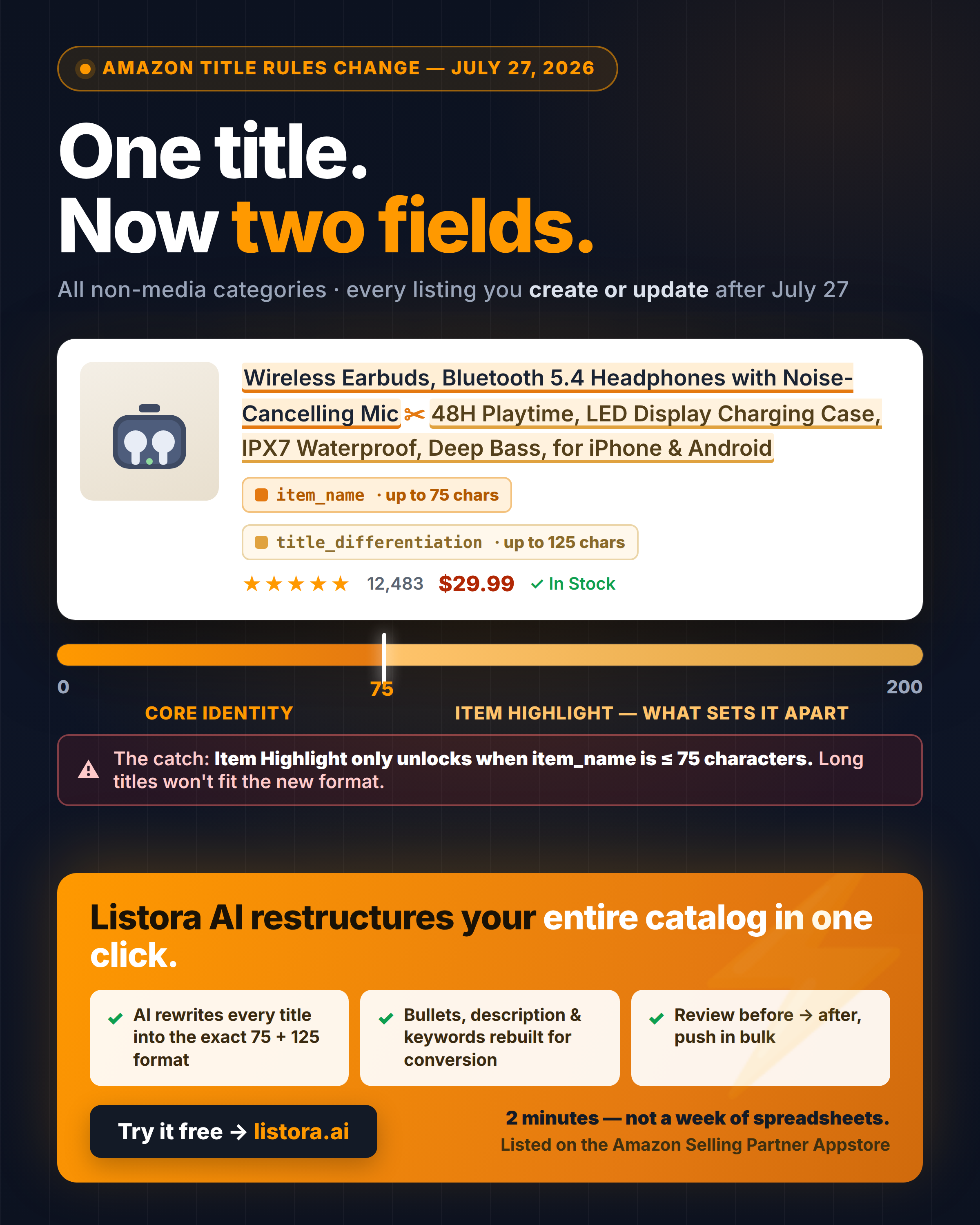
Starting July 27, 2026, titles become modular — split into two components:
| Field | Max length | Purpose | |
|---|---|---|---|
| 1 | item_name | 75 characters | Core product identity — brand, product type, key attribute |
| 2 | title_differentiation (Item Highlight) | 125 characters | Differentiating details — features, size, use case, variants |
Total capacity stays at 200 characters. What changes is the structure: Amazon now wants your product's identity separated from the details that distinguish it.
The restriction most sellers miss
Here's the fine print that matters more than anything else in Amazon's announcement:
The Item Highlight field can only be used when item_name is 75 characters or fewer.
Read that again. If your current titles run long — and for most competitive categories, they do — they don't map cleanly into the new format. You can't just keep a 130-character item_name and bolt on a Highlight. The first field has to come in at 75 or under before the second field unlocks at all.
That means for most catalogs, complying isn't a copy-paste job. It's a rewrite: deciding what belongs in the first 75 characters, and restructuring everything else into the 125-character Highlight.
Who is affected — and who isn't
Affected:
- All non-media product types, in all Amazon stores except Saudi Arabia, Egypt, Türkiye, and the United Arab Emirates
- Any seller or tool that creates or edits listings via the Listings Items API or the JSON_LISTINGS_FEED feed type
- Every listing you create or update on or after July 27, 2026
Not affected (for now):
- Media categories (books, music, video)
- Stores in the four exempt countries above
- Existing listings you don't touch. Amazon has confirmed this is a gradual rollout: current listings stay as they are unless you submit an update, and sellers can migrate at their own pace through 2026.
That last point sounds reassuring, but think about what it actually means in practice. Every price-irrelevant edit you make after July 27 — updating a bullet, refreshing keywords, fixing a typo, syncing from your listing tool — should follow the modular structure. Your catalog is effectively on a countdown that starts the next time you touch each listing.
Why is Amazon doing this?
Amazon's stated reason: separating core product identity from differentiating details enables "more consistent and structured product discovery across stores."
Translated from Amazon-speak: titles have become keyword-stuffed walls of text, and Amazon wants structured data it can render differently across surfaces — search results, mobile, Rufus (its AI shopping assistant), voice, and international stores. A clean 75-character identity plus a structured Highlight gives Amazon's systems something far more usable than a 200-character run-on sentence.
For sellers, the strategic read is straightforward: structured titles are the direction of travel. Listings that adopt the modular format early are aligned with how Amazon wants to surface products next — and the sellers who restructure thoughtfully (rather than truncating in a panic) keep control over what shoppers see first.
How to restructure a title: a worked example
Take the most recognizable title format on Amazon — the keyword-stuffed electronics title, here at 187 characters:
Wireless Earbuds, Bluetooth 5.4 Headphones 48Hrs Playtime with LED Display Charging Case, IPX7 Waterproof Earbuds with Noise Cancelling Mic, Deep Bass in-Ear Headphones for iPhone Android
Restructured for the modular format:
item_name (68 characters):
Wireless Earbuds, Bluetooth 5.4 Headphones with Noise-Cancelling Mic
title_differentiation (96 characters):
48H Playtime, LED Display Charging Case, IPX7 Waterproof, Deep Bass In-Ear, for iPhone & Android
The identity (what it is) leads. The differentiation (why this one) follows. Nothing valuable was deleted — it was reorganized into the structure Amazon will actually reward.
Now multiply that exercise by every ASIN in your catalog: count characters, decide what survives the first 75, rewrite the remainder into a coherent Highlight, and keep your keyword coverage intact while you do it. For a 500-ASIN catalog, that's genuinely a week of spreadsheet work — and one miscounted character means a failed submission.
The one-click alternative: how Listora AI handles it
We built the modular title migration directly into Listora's AI Optimize flow, so restructuring an entire catalog takes minutes instead of days:
- Select your listings — one, fifty, or your whole Amazon catalog.
- Hit AI Optimize. Listora rewrites every title into the exact 75 + 125 modular format automatically — core identity into
item_name, differentiators into the Item Highlight — while rebuilding bullets, description, and backend keywords for conversion at the same time. - Review before → after. Every listing gets a quality score on both sides of the rewrite, so you can see the lift before anything changes. Nothing touches Amazon until you approve it.
- Push only what you want. Field-level checkboxes let you push just titles, or titles + bullets + description + keywords — in bulk, in one click.
Because Listora pulls real Amazon search terms into the optimization, your restructured titles don't just comply with the new format — they rank for what buyers actually type.
A week of manual restructuring becomes a two-minute review.
Beyond the new rule: fixing broken and underperforming listings at the same time
Here's the opportunity most sellers will miss: if you're going to touch every listing anyway to meet the modular title format, this is the moment to fix everything else that's quietly costing you sales.
If your listing is suppressed or not showing in search. Search-suppressed listings and quality alerts are usually triggered by exactly the problems this migration surfaces — titles that are too long, missing attributes, or non-compliant formatting. A title over the character limit is one of the most common causes of a suppressed Amazon listing, and after July 27, format violations become easier to trip. Listora's compliance pre-flight validates listings before they're pushed, so fixes go through the first time instead of bouncing back with flat-file errors.
If your listing gets impressions but no clicks. Low CTR is usually a title problem: keyword-stuffed, front-loaded with the wrong information, or truncated mid-sentence on mobile. The modular structure is actually a gift here — a clean 75-character identity is what shoppers see first, everywhere. AI Optimize rewrites for the click, not just for compliance.
If your listing gets traffic but doesn't convert. That's bullets and description territory. Since AI Optimize rebuilds those alongside the title in the same pass — with real Amazon search terms worked into backend keywords — an underperforming listing comes out the other side restructured end to end, with a before → after score showing exactly what changed.
If your listing simply isn't ranking. Amazon's algorithm can only rank you for keywords it can find. The optimization pass redistributes your keyword coverage across title, Item Highlight, bullets, and backend search terms so nothing valuable is lost to the 75-character cut — it's relocated to where it still indexes.
One migration pass, every listing problem addressed at once. That's the efficient way to spend the July 27 deadline.
What you should do this week
- Audit your title lengths. Export your catalog and flag every title over 75 characters — those are the ones that can't use the Item Highlight field as-is. (Our free Amazon Listing Grader scores any listing in seconds.)
- Prioritize your movers. Any listing you expect to edit after July 27 (price-competitive ASINs, seasonal items, anything in active optimization) should be restructured first.
- Don't truncate — restructure. Chopping titles at 75 characters throws away ranking signal. Move it into the Highlight instead.
- Migrate on your schedule, but start now. The gradual rollout through 2026 is breathing room, not a reason to wait. Early movers get structured, compliant, keyword-rich listings indexed while competitors scramble.
FAQ
When does Amazon's modular title structure take effect? July 27, 2026, for all listings created or updated on or after that date in non-media categories.
What is title_differentiation on Amazon? It's the new "Item Highlight" attribute — a field of up to 125 characters for differentiating details (features, size, use case), used alongside a shortened item_name of up to 75 characters. It's visible now in product type schemas via the Product Type Definitions API.
Do I have to update my existing Amazon listings? Not immediately. Existing listings are unaffected until you submit an update. But any create or update after July 27, 2026 should use the modular structure, and Amazon is encouraging sellers to migrate through 2026.
What happens if my item_name is longer than 75 characters? You can't use the Item Highlight field. To take advantage of the full 200-character capacity under the new structure, item_name must be 75 characters or fewer.
Does this apply to all Amazon marketplaces? It applies to all stores except Saudi Arabia, Egypt, Türkiye, and the United Arab Emirates, and excludes media product types.
Why is my Amazon listing not selling? The most common causes are a weak or truncated title (low click-through from search), thin bullets and description (traffic that doesn't convert), missing backend keywords (you never appear for relevant searches), and compliance issues that suppress visibility. Running a listing through a grader identifies which of these applies — then an optimization pass fixes title, bullets, description, and keywords together. And if other sellers share your listing, check whether you're winning the Buy Box (Featured Offer) — losing it stops your sales even when the listing itself is perfect.
How do I fix a suppressed Amazon listing? Check Seller Central's "Fix your products" dashboard for the specific quality alert — the usual culprits are titles exceeding character limits, missing required attributes, or policy-violating formatting. Correct the flagged field and resubmit. A pre-flight compliance check before pushing updates prevents most suppressions from happening in the first place.
Why is my Amazon listing not showing up in search? Either it's search-suppressed (quality/compliance issue), missing the keywords buyers actually use, or too new/low-ranked to surface. Verify the listing is active with no quality alerts first, then rework title and backend search terms around real Amazon search data.
How do I bulk update my Amazon titles to the new format? Through the API you'd submit item_name and title_differentiation as separate attributes per the Product Type Definitions schema — for each ASIN individually. In Listora, you select your listings, run AI Optimize, review the before/after output, and push all approved titles in one bulk operation.
Can Listora update my titles to the new format automatically? Yes. Listora's AI Optimize rewrites titles into the 75 + 125 modular format in bulk, shows before/after quality scores, and lets you push approved changes to Amazon in one click. It rebuilds bullets, descriptions, and backend keywords in the same pass — so broken, suppressed, and underperforming listings get fixed alongside the title migration. Start free →
Listora AI is a multichannel listing and operations platform for Amazon, Walmart, eBay, Shopify, Flipkart, Meta, and TikTok Shop — listed on the Amazon Selling Partner Appstore and a Walmart Verified Solution Provider.